
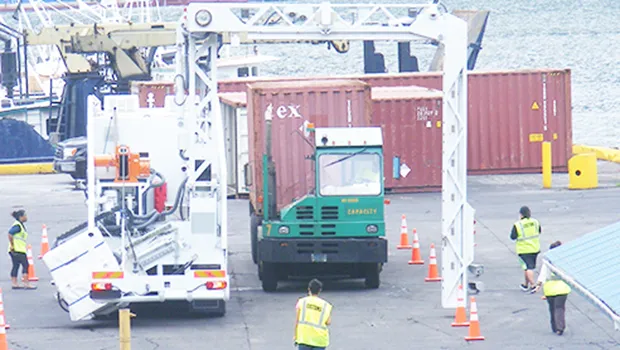
ASG Deputy Treasury for Revenue, Keith Gebauer, has outlined for port users guidelines of standards of processing, inspection of incoming cargo including imported vehicles, scanning process for vehicles and request for after-hours customs agents. In a June 1 email to local port users, he said they are not new regulations, but the Customs Division “is simply establishing guidelines to improve our service.”
Gebauer, the current acting Chief of Customs, said in his email, “A core objective of the Customs Division is to process incoming cargo and shipments as efficiently as possible.”
A five-page memorandum, dated June 1st, was also sent to port users providing it says clarity regarding minimum requirements for each signed and submitted Declaration Entry form, documentation for importing vehicles into the territory and an update on Customs scanning procedures.
According to Gebauer, the ‘clarity’ memo followed an “internal assessment” of the Customs processing and container inspection operation and is to ensure Customs conducts its processing and inspections in a timely and efficient manner, and is effective June 15th.
He also noted that some of the Customs regulations outlined in the memorandum are not new, and already exist, but they “may have been implemented inconsistently.”
Gebauer emphasized that Customs “primary objective is to provide clarity for all Port Users to improve our processing and inspection process.”
The memo covers areas such as declared value of imported vehicles, freight forwarder cargo inspections, declaration of entry forms, and after hour inspections.
The acting Chief of Customs apologized to Port Users for the inconvenience that the revisions and adjustments to the current process may cause but said that “as previously stated, scanning each container, pallet or parcel accurately and fully is our primary objective and any accommodations would be adjusted if it impacted our ability to scan appropriately.”
DECLARED VALUE OF IMPORTED VEHICLES
For processing a vehicle entry into the territory, Customs Division established standards to ensure consistent and fair interpretation of Customs statutes.
For example, the Customs processing unit is to evaluate each vehicle Declaration of Entry to determine the “authenticity” of the declared value of imported vehicle, according to the memorandum.
While genuine Bills of Sales may be presented and accepted, the new standard is that the processing Customs agency may use alternate valuations, including vehicle valuations such as “Blue Book” services to determine the fair market value of the imported vehicle when the submitted vehicle valuation is not reasonably based on fair market value, it says.
In cases where a submitted vehicle valuation is under review by the Customs processing unit, importers maybe also be required to provide additional proof of purchase such as the form of payment used to purchase the vehicle.
SCANNING PROCESS UPDATE
Part of Customs Division’s original scanning launch included permitting importers/shippers, as well as freight forwarders, to determine the scanning option if it did not impact Customs ability to scan the incoming cargo.
According to Gebauer, the Customs container scanner operators have determined that containers must be on a trailer to have a complete scan of the contents of the container. Therefore, effective June 15th this year, “scanning of containers containing vehicles will no longer be permitted on the ground”.
Additionally, vehicles will no longer be “de-vanned” from the containers and staged for scans as had been the previous allowable practice; and the scanning process will require having the vehicle scanned off the ground.
Shippers were also informed that vehicles shipped via “Break Bulk” would be scanned via method best suitable, as determined by the Customs scanning unit.
Responding to Samoa News inquiries, Gebauer explained that prior to launching the scanning process in April, vehicles were "de-vanned" from a container for inspection by Customs agents — container inspection & K-9 unit.
“When we launched the scanning process, this process continued and the scanning was included in the normal inspection process prior to release,” Gebauer said last Friday afternoon. “Vehicles were organized in the scanning zone and the scanning process completed.”
He said that over the first sixty-days of operation and as the M60 container scanner operators have gained valuable experience operating the equipment, they have determined to capture a full image of the object, this practice needed to be adjusted.
“As we move forward, the practice of ‘de-vanning’ vehicles from containers will cease effective as stated in the memorandum,” Gebauer explained. “Vehicles shipped via container will need to be scanned in that manner.”
“While we recognize this may be an inconvenience, Customs has always maintained the position that our ability to accurately scan any incoming cargo takes priority over any other factors,” he said. “Customs remains committed to keeping our borders secure and executing the scanning process accordingly.”
CARGO SCAN AT AIRPORT
In the June 1st memorandum, it also addresses the scanning process of cargo at the airport, in which the scanning van will continue to offer to freight forwarders the option to cover the cost of scanning their consignee’s shipments — with the consignee’s approval — as allowable under current practices.
Freight forwarders have been told that they may stack multiple consignees on a single pallet — in a safe and reasonable manner not exceeding 6 feet — and pay the single pallet rate, only if the freight forwarder accepts the associated scanning charges, according to the memorandum.
However, if the freight forwarder or the consignee who chooses not to utilize this option, the scanning process and applicable fees — as prescribed by law — will be assessed.
DECLARATION OF ENTRY
The memorandum also outlined the standard process for completing a Declaration of Entry form pursuant to local law. For example, it says that each consignee or their representative who signs the Declaration of Entry form is responsible for the contents of the shipment. Addition, each consignee is responsible for submitting “accurate invoices” which “clearly describes the contents of the imported goods.”
The memorandum also outlined information that should be on the invoice that “must include ‘Original Stamp’ identifying purchase date”.
Customs Division reserves the right to review each signed Declaration of Entry form and invoices submitted for authenticity and “should the process or inspecting agent deem an invoice to be lacking authenticity in way, shape or form, may reject the submitted invoices,” according to the memorandum.
AFTER HOUR REQUEST
The memorandum also outlined the guidelines of After Hours Request process and deadline for container inspection. It made clears that “vessel inspection” is not subject to container inspection guidelines for after hours.
For example, any and all “after hour” requests must specify a minimum two-hour time frame to ensure Custom agents are scheduled appropriately. If consignee fails to produce the container for inspection during the allotted timeframe, additional fees will be applied.
In order to ensure adequate coverage and timely scheduling for all requests for Customs agents to be available, requests must be submitted in writing to the Customs Office at the Port facility, which has reopened recently.
Port users are encouraged to contact Gebauer if they have any questions.


Comments
Sorted by BestComments are powered by Disqus. By commenting, you agree to their privacy policy.
Powered by Disqus