
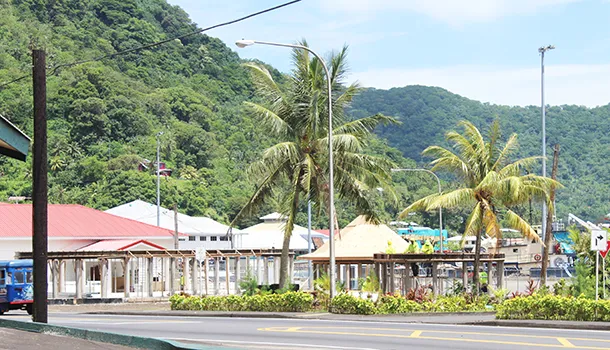
Pago Pago, AMERICAN SAMOA — This Samoa News photo taken yesterday shows a construction crew working on the second Faleo’o at the new Sogelau Monument and Samoan Village project next to the Jean P. Hayden Museum in Fagatogo.
Samoa News had mistaken reported in a photo caption several weeks ago that the area — the old location of the Fagatogo fire station — was cleared to construct the new home of the American Samoa Visitors Bureau, whose officials told Samoa News yesterday was “incorrect”.
Arts Council executive director Mary Lauagaia Taufete’e said yesterday that this is a project overseen by the Governor’s Office, for the future home of the Sogelau Monument and Samoan Village. The site has two Faleo’o and another building.
Purpose of the project, which was spearheaded by Gov. Lolo Matalasi Moliga, is bringing back the importance of Sogelau’s role in the 120 year history of American Samoa, said Taufete’e.
Sogelau Hill — atop the mountain side, above the Samoa News building in Fagatogo — was the site of the first raising of the United States flag on Apr. 17, 1900, marking the islands of Tutuila and Aunu’u becoming American Samoa.
“While the current project is not located on a Sogelau Hill, the governor wants to keep that part of America Samoa’s history alive,” said Taufete’e.
The last time, in Samoa News records, that Sogelau Hill was part of public recognition, was during the Centennial Flag Day Celebration in April 17, 2000, when American Samoa marked its 100 years relationship with the US.
During that celebration, 300 eighth graders from local schools sang the American Samoa anthem and the U.S. Navy/Marine Band played the United States national anthem as flags were raised at Fagatogo Malae. At the same time, a special 60-foot American flag was raised on Sogelau Hill - which was clearly visible from the Fagatogo Malae, Samoa News reported at the time.
According to the American Samoa Historic Preservation Office (ASPO) online information, it was US Navy Capt. B.F. Tilley who raised the US flag on Sogelau Hill. It also says that since the raising of the flag, the site has been abandoned and the front of the hill was cut away and used to fill in the part of the reef in Pago Pago Harbor to create land to expand the Naval Station.
In 1997, ASPO discovered the remains of this important site; six "iron caps," taken from the 1900 wharf construction, used to anchor the original flag pole. After the site was documented by ASHPO archaeologists, it was restored in a partnership developed between a Boy Scouts of America Eagle Scout (Mr. Eti Vele) and ASG in time for the Centennial event.
Local News
Sogelau Monument and Samoan Village Project going up by Museum
Comments
Sorted by BestComments are powered by Disqus. By commenting, you agree to their privacy policy.
Powered by Disqus