
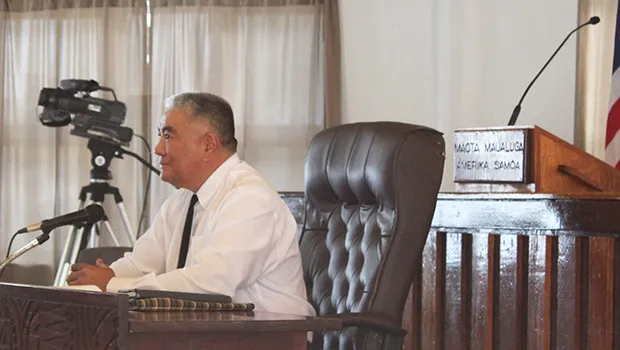
Pago Pago, AMERICAN SAMOA — China tops the list of countries with the highest amount of foreign remittances sent from American Samoa, according to Robert Ho Chee, the Commissioner for the Office of Financial Institution, a bureau of the ASG Treasury Department.
Ho Chee shared the list during yesterday’s Senate Budget and Appropriations Committee hearing on an administration bill which — again — seeks to establish by law the Money Services Business Regulatory Act, which would regulate money transfer businesses in American Samoa.
Responding to Sen. Tuaolo Manaia Fruean's questions, Ho Chee said Samoa placed second, followed by the Philippines, and then Vietnam.
Tuaolo inquired about New Zealand, to which Ho Chee said that not many individuals do foreign remittances but many businesses use banks instead of money transfer businesses.
(Tuaolo asked Ho Chee not to reveal the total amount of money sent to each of these countries.)
Earlier in the hour-long hearing, there was a question from the committee on the amount of money that can be sent out of American Samoa. Ho Chee said there is no limitation on “domestic” remittance — sending to any part of the US — as there is federal “money laundering laws” which covers them.
However, there are limitations for “foreign remittance”, he said, pointing out for example, that at Western Union, it’s $7,000 US dollars per day, per person for places such as China or Samoa. And this limit is part of their franchise, he added.
Tuaolo asked how much the government gets out of the $7,000 per person, per day limit and Ho Chee responded, only 1% based on current law.
Under the Administration bill, there are fees imposed that will go towards the government and do not include fees that money transfer businesses impose on customers.
Ho Chee said Western Union charges a fee for foreign remittances, but “the key to any business making money off the transaction is the foreign exchange [rate]”. He explained that the money is sent from here in US dollars and upon arrival at the country, it's converted to that country’s currency.
“So foreign exchange is where they make their money, not so much the fee,” he pointed out.
In a follow up question, Tuaolo asked, “would you be suspicious if $7,000 is sent to China everyday?” because “if there is smoke, there is a fire”.
“Sir, my nature, as a regulator, there’s always that gut feeling, there’s always that suspicion,” was Ho Chee’s response.
If the Fono passes this bill, “it gives me the tools to enforce and protect our people,” he added. Ho Chee reiterated several times that the bill addresses outgoing remittances sent through money transfer businesses. (See Samoa News Apr. 2 edition for details of bill).
Committee chairman, Magalei Logovi’i raised several questions on the fees, including the fee per location, citing Western Union — which has more than one location on island.
Based on his research, Ho Chee said Western Union has 10 locations here and it all has to do with ownership. He explained that a person from American Samoa owns five locations and the other five are a franchise from Samoa.
Under this bill, that’s 10 locations, each with a license fee of $1,000, according to Ho Chee.
According to the bill, 50% of the fees collected shall be earmarked for the operations of OFI and the balance to be deposited in the ASG General Fund. Ho Chee told the committee that he estimates that about $500,000 to $600,000 annually will be collected from the fees.
Currently OFI is funded with about $1 million of bond proceeds issued in 2015 by the American Samoa Economic Development Authority.
Ho Chee said OFI is currently being funded by these proceeds, and once it's all used up, they will need a new funding source: proceeds from the fees collected under this bill.
Magalei said he agrees with the importance of the proposed law, but he has concerns over the full authority “given to one person to make decisions” — as stipulated in several provisions of the bill.
For example, one provision of the bill states that before a license is suspended or revoked for a money transfer business for failing to comply with the proposed law, the Commissioner shall hold an order to show cause hearing.
Magalei asked if there is a board or a panel who would conduct the hearings. Ho Chee said it's just him, but noted that, like all his decisions, before they are made, he seeks advice and suggestions from others.
The committee is looking at voting on the bill early next week
Comments
Sorted by BestComments are powered by Disqus. By commenting, you agree to their privacy policy.
Powered by Disqus