
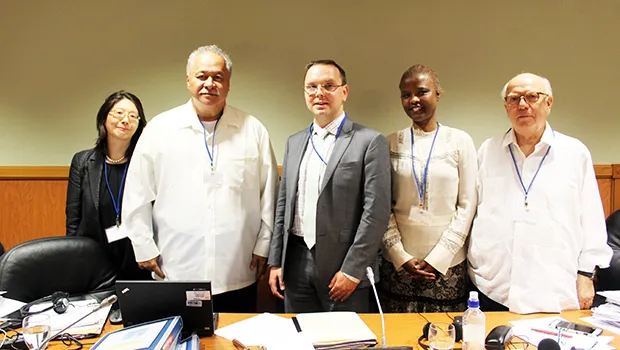
American Samoa’s “external relationship” with the Administering Power — the United States — has “serious democratic deficiencies,” says Tapaau Dr. Dan Aga, executive director of the ASG Office of Political Status, Constitution and Federal Relations, during his presentation at last month’s United Nations Decolonization Committee’s Caribbean Regional Seminar hosted by St. Vincent and the Grenadines.
Tapa’au presented American Samoa’s perspective at the seminar, held May 16-18, on behalf of Gov. Lolo Matalasi Moliga. And a copy of his presentation speech was released online yesterday on the Decolonization Committee's website, along with presentations by other delegates.
At the outset of his address, Tapa’au asked two questions: “Given our present government and way of life, do we, in American Samoa, live under a regime in which colonization must be eradicated? Do we consider ourselves a ‘colonized people’?” He responded that the answer is “No. We do not”.
“Is there a ‘widespread yearning’ for political independence?” he also asked and offered the reply, “No. There is not.”
Tapaau observed that the Decolonization Committee might asked “if our people do not at least thirst for freedom”.
“We answer differently because in American Samoa we know and enjoy great constitutional freedom such as the freedom of speech and freedom of religion,” he told the seminar. “We are aware that the rights and freedoms of American Samoa’s constitution are more about processes ‘internal’ to the territory, whereas political status is more about the territory’s ‘external’ relationship with the Administering Power.”
As an unincorporated territory, he notes three specific US constitutional rights not extended to American Samoa — US citizenship (persons born in American Samoa are US Nationals), right to vote for the US President, right of American Samoa’s delegate in Congress to vote for legislation.
“In spite of the democratic deficiencies, our loyalty and patriotism as a people is unchallenged,” he declared. “These deficiencies are make more acute when considering the sons and daughters of American Samoa who serve in the US Armed Forces.”
He noted that when joining the US military, American Samoans swear an oath to “support and defend the Constitution of the United States...”
“Therein lays the irony of young men and women serving under a flag for which their island home is not represented,” he said. “For how can the sons and daughters of American Samoa give their lives defending a constitution that does not in turn give them all its rights?”
“This is why many argue that the differential treatment between territories and states is racist and discriminatory,” he notes. “This is a political inequality and unjust application of the US constitution that exists in the unincorporated jurisdictions of America.”
While its easy to assume that the way to rectify this inequality is for American Samoans to become US citizens by seeking US Congressional approval, Tapaau informed the seminar that the citizenship issue was raised in a federal lawsuit against the US government.
As previously reported by Samoa News the lead plaintiff in the case, is local resident Leneuoti Tuaua and the complaint went all the way up to the US Supreme Court, which in the end sided with the lower federal court in dismissing the case.
In his presentation, Tapaau pointed out that local elected leaders opposed birthright citizenship for American Samoans. He also cited quotes from the courts’ ruling in dismissing the citizenship lawsuit, “it is ‘impractical and anomalous’ to impose citizenship by judicial fiat — where doing so requires [the courts] to override the democratic prerogatives of the American Samoan people themselves.”
He told the seminar audience, “This is the paradox of American Samoa — instead of securing further integration with birthright citizenship, our act of self-determination was to oppose it.”
The governor warned that birthright citizenship, “would have created political complications with a devastating impact on our land tenure system and usurpation of our rights to determine the political format we wish to adopt,” Tapaau recalled for the audience what Lolo had said about this issue.
Samoa News will report next week on the rest of the issues raised in Tapaau’s presentation as well as other discussions from the seminar.

Comments
Sorted by BestComments are powered by Disqus. By commenting, you agree to their privacy policy.
Powered by Disqus